Operations6 min read
How to Reduce Paperwork in Custom Manufacturing
Paperwork never appears on a manufacturer’s budget, but it is paid for in rework, delay and invisible labour. Where the cost actually hides, and a simple way to measure your own exposure.
Slab Team · 30 July 2026
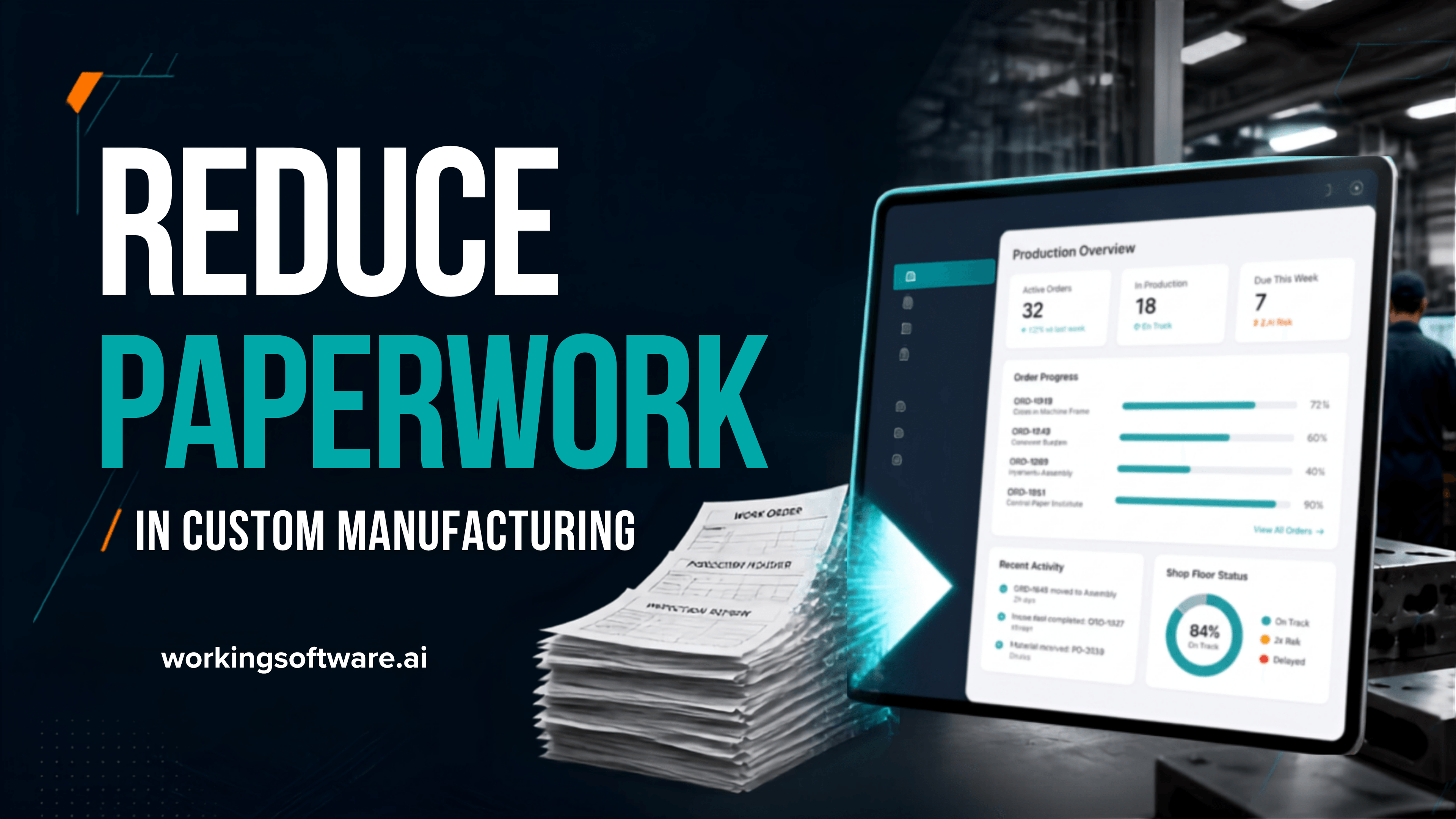
Paperwork rarely appears on a manufacturer’s budget, but it still has a cost. The hours spent re-entering information, updating spreadsheets, chasing approvals, and correcting errors add up across every order, yet they’re rarely measured alongside materials or labor. It makes administrative work a hidden cost of every job paid for in employee hours, spread across the business, and difficult to manage because no one is tracking it.
The Three Places Paperwork Actually Costs You
Talk to manufacturers about paperwork and the default answer is "it's annoying" or "it's slow." Those are real issues, but they're not the expensive part. The expensive part shows up in three specific places.
-
Rework. A measurement written by hand, photographed, and re-typed by someone else has at least two ways to go wrong before it ever becomes a quote. A misread number, a transposed digit, a note that didn't make it from the paper to the system — each one is small, and each one occasionally turns into a wrong order that has to be remade from scratch. Rework is almost always a paperwork problem underneath.
-
Delay. Paperwork and emails don't typically move at the speed of the business. They move at the speed of whoever's available to process them. A quote sitting in someone's inbox for two days because they're behind signals a structural problem. The information has nowhere to go except through a person, and people have limits. Every stage that depends on a manual handoff adds latency that compounds across the full order lifecycle, from first quote to final delivery.
-
Invisible labor. This is the biggest one, and the toughest to see, because it's spread across so many people that no single person's time looks like the problem. The back-office staffer retyping specs into accounting software. The production lead cross-checking a paperwork order against what's actually on the floor. The owner manually reconciles a job's actual cost against what it was quoted at, weeks after the fact. None of it looks like "the paperwork problem" from the inside. All of it is.
Why This Keeps Getting Missed
This pattern extends well beyond door manufacturing. Machine shops, cabinet makers, metal fabricators, and other custom manufacturers face the same problem: administrative work is spread across people and processes, so its true cost is easy to miss.
Twenty minutes spent re-entering information here and an hour fixing an error there may not look significant individually. Across five employees and every stage of an order, however, those hours become a substantial operational cost to the business.
The same applies to paperwork and email. A handwritten measurement, emailed photo, or manually calculated quote introduces room for errors that become harder to catch as order volume grows. The issue isn't that people are careless—it's that manual tools are difficult to maintain accurately at scale.
What "Reducing Paperwork" Actually Means in Practice
The conversation tends to go vague when you're told to “go digital,” or “modernize your workflow.” This only matters if it changes how work gets done. In practice, that means entering measurements and specifications once, using existing pricing and material data to build quotes, carrying approved orders directly into production, and keeping inventory tied to the jobs that actually require it. Invoicing should then come from the completed order rather than being rebuilt manually.
Surprisingly, none of this requires complicated technology. The real improvement comes from connecting the systems that already manage the same job, instead of relying on paper, email, spreadsheets, accounting software, and individual memory to keep everything aligned.
Why This Matters More in Custom Door Manufacturing
Manual processes become increasingly difficult to sustain as production volume grows, but custom manufacturing has an additional challenge. The work itself does not repeat predictably.
A manufacturer producing the same set of standard products can gradually standardize its quoting, purchasing, production, and inventory processes. Once the formulas and workflows are established, a spreadsheet can handle a surprising amount of the work.
However, custom door manufacturing is different. Each order can vary by dimensions, material, construction, hardware, finish, and other specifications. That means there is less opportunity to rely on a fixed template. Every new order requires careful decisions, calculations, and information to move through multiple stages of the business. As order volume increases, the manual process does not necessarily become more efficient; it just creates more opportunities for duplicated work, inconsistent information, material shortages, costing errors, and delays.
Slab is designed to address this operational gap that costs businesses time and money. Rather than treating quoting, order management, production, inventory, and invoicing as separate activities, Slab connects them around the same job. A measurement entered during quoting can carry into the order, production can work from the approved specifications, material requirements can be tied to the job, and invoicing can be generated from the completed order. The objective is to prevent the same information from being recreated, misinterpreted, or manually transferred at every stage.
Pricing starts at $100 per month, which is particularly relevant for the market it serves. Many manufacturing management platforms are priced and implemented for larger operations with substantial IT budgets. For a mid-sized custom door manufacturer, a careful consideration is whether the software can eliminate enough administrative work, errors, and operational friction to justify its cost without requiring an enterprise-level investment.
A Simple Way to Measure the Cost
Do you know that you can estimate your exposure without hiring a consultant?
Take one completed order from last month and trace its journey from initial quote to final invoice. For each stage, record how many times key information such as measurements, specifications, pricing, quantities, or customer changes was manually entered, copied, or verified by someone else.
Then estimate the time spent on those handoffs, corrections, and follow-ups. Multiply that by your average monthly order volume.
The result won't be a perfect accounting of administrative cost, but it will give you a practical estimate of how much time your current workflow consumes. More importantly, it shows where the biggest sources of duplicated work and avoidable errors are hiding.