Software5 min read
Why “Just Buy an ERP” Might Be Bad Advice For Mid-Sized Custom Door Manufacturers
ERP sounds like the obvious next step when spreadsheets stop keeping up. For a mid-sized custom door shop it often means an eighteen-month, six-figure answer to a much narrower question.
Slab Team · 23 July 2026
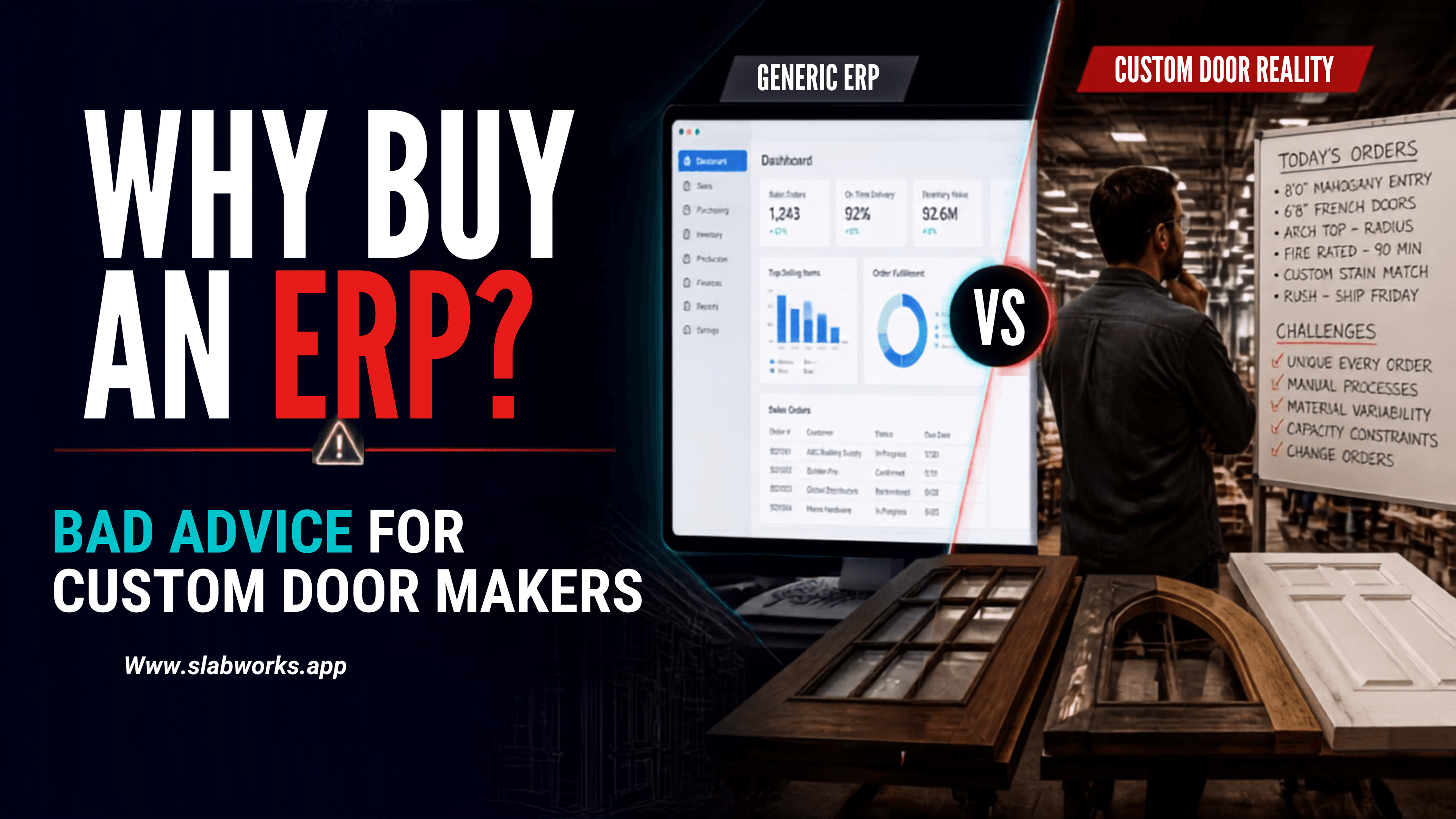
There’s a specific moment in almost every growing manufacturing business that necessitates a change, especially when spreadsheets aren’t efficient enough to keep up with growing demand. You’d hear from someone on the team, often with a background at a bigger company, saying the obvious-sounding thing: “We need an ERP.” It sounds like great advice, and many mature companies run ERPs, so that’s a logical next step.
Eighteen months and a six-figure implementation later, some of those companies are now operating with a system employees can actually understand, but built for a scale they haven’t reached yet, that took longer to configure than it’s saved in time. This is a real problem, and it’s a well-documented pattern across manufacturing, and it’s worth noting before you assume “ERP” is the solution to your CRM problem.
What ERP Actually Means
Enterprise Resource Planning (ERP) software is a powerful tool that’s built to unify everything happening across an enterprise (from finance, HR, supply chain, manufacturing, and more) into a single system of record. For a large, multi-division manufacturer with dedicated IT staff and complex cross-department dependencies, ERP makes perfect sense. It’s also why implementing one is a serious undertaking, and you’re not just installing another software—you’re re-architecting how information moves through an organization.
Where businesses get it confused is when they associate “ERP” with “serious business software” in general, which leads many mid-sized manufacturers to assume it’s the only category worth considering. It isn’t. There’s a second category focused on operational software built around a specific workflow rather than an entire enterprise.
The Trade-Offs Between Manufacturing ERPs and Custom Manufacturing Software
Cost
When it comes to a full ERP implementation for manufacturers, it costs around $30,000 to $40,000 in setup and configuration fees before a single order gets processed, with ongoing costs in monthly subscription fees once it’s live all this before factoring in the time required to manage the rollout. Custom manufacturing software built for a specific manufacturing niche typically operates at a fraction of that cost, with fair-value subscription pricing instead of an enterprise contract.
Implementation time
ERP rollouts are measured in months, sometimes even exceeding a year. This is because the system is being configured to model the entire business, not just a single workflow. Custom manufacturing software is built around a workflow that already matches how a custom manufacturer operates. This custom software can typically be live in days or weeks.
Customization depth vs. customization speed
This trade-off is one that people underestimate. A full ERP can, in theory, be configured to do almost anything, but “theoretically” is far from practicality. Deep customization involves development tickets, consultants, and a queue. A custom manufacturing software trades some of that theoretical ceiling for practical speed.
Learning curve
ERPs are notorious for requiring dedicated training, sometimes a role dedicated to administering the system itself. Custom manufacturing software is built around a single, familiar workflow — quote, order, production, inventory, invoice — and requires less of a team that’s already focused on other responsibilities.
When a Full ERP Is Actually the Right Call
Most vendors in this space won’t tell you that there are manufacturers for whom a full ERP is a genuinely correct choice, and pretending otherwise to make a sale is how the industry earned its reputation for overpromising. If you’re operating multiple facilities, running complex multi-entity finance, integrating deeply with enterprise-scale supply chain partners, or have a dedicated IT team who can own a long implementation, the prospect of an ERP may be exactly what you need.
The bottom line is if your operational complexity comes primarily from the manufacturing workflow itself rather than from enterprise-wide finance and multi-division coordination, you’re very likely being sold more “software” than your problem requires.
Why a Focused Platform May Fit Better
For a mid-sized custom door manufacturer, the question shifts from whether an ERP can handle the business. It can do so well. The question is whether you need the complexity, implementation effort, and cost that come with an enterprise platform.
Slab takes a much narrower approach. It brings customer management, quoting, orders, production, inventory, and invoicing into one workflow designed specifically for custom door manufacturing. That means the software is built around the operational problems a door shop actually faces rather than requiring the business to adapt its processes to a much broader enterprise system.
The pricing follows the same philosophy. Slab starts at $100 per month, while traditional ERP implementations can involve tens of thousands in setup costs and thousands more each month. The difference isn't simply about being cheaper. It's about paying for the level of functionality and complexity the business actually needs.
The Decision Comes Down to Fit
If the most significant challenge you face day-to-day comes from quoting for custom jobs, coordinating production, tracking materials, and keeping customer information accurate from order to invoice, software built around those activities is likely to deliver practical value.